South Carolina  Movies Filmed in SC The Patriot The Patriot, Behind the Scenes
This account was submitted by reenactor, Keith Kankovsky. Keith was on site filming
The Patriot for nine days with friends, fellow reenactors. Keith's friend, Rick Toone, kept the journal below. Keith has added a few details to Rick's account, which are noted in parentheses.
Filming The Patriot – The Inside Story
This short journal is a combination of several reenactors' diaries. These events took place near Rock Hill, SC in September 1999 during the filming of Columbia-TriStar Pictures The Patriot, starring Mel Gibson. – Keith Kankovsky
Rick Toone, 1999
We arrived in S.C. for two days of inactivity because they had postponed the shooting schedule. We took the opportunity to tour the area, including two Revolutionary War battlefield sites (Kings Mountain and Cowpens) that we would be portraying in the film. Good historical background.
The area was what you'd expect for remote, rural, South Carolina; cotton and tobacco fields, trailer parks, and old plantations. Pickup trucks. TV satellite dishes. Dirt roads. BBQ.
The film is - at this point - called
The Patriot starring Mel Gibson, whose character is loosely based on Francis Marion "The Swamp Fox" of the Revolutionary War. The actual Francis Marion was instrumental at turning the tide of the Revolution against the British in the south, primarily because he and his under-equipped band of raiders harassed the British and kept up American morale. They accomplished this by using the swampy terrain to their advantage to strike quickly at the British and disappear again into the wilderness. This was a new tactic of fighting that the European-trained British had no way to effectively counter. Marion and his men did this under extreme hardships: year-round fighting, living in swamps, eating a diet consisting mainly of sweet potatoes - all of this as self-equipped, unpaid volunteers.
We'll see how closely the film matches the reality. Dad and I were to portray two of Marion's small band of Volunteer militia. We camped in a large pasture belonging to the Darby farm that Columbia Pictures rented for $2 million dollars for the duration of the filming. The farm must have measured at least 6 miles on a side, the terrain composed of rolling fields of cotton and grasses, woods, and several substantial streams - all quite beautiful and located far from airports and roads.
This farm had two separate filming sets; one was a rural cabin that Columbia Pictures built then burned for one scene, the other was the ruins of a mansion that sat atop a hill - which was where Dad and I were to be involved in the filming of the battle scene. (This provided the ideal photo op for those of us with cameras as well! - KK) Every single part of the mansion was constructed of plaster and fiberglass by the props department; the trees that surrounded the ruins were actual trees, cut a mile distant in the woods and "planted" in holes, with every leaf stapled on. Columbia was filming simultaneously at 17 separate sets in the Charleston area, all with similar attention to detail. (Not to mention the several dozen fir trees tied to a distant bridge within camera view! - KK)
Our first working day was in wardrobe, where we were fitted with costumes. Wardrobe was a rented empty department store an hour's drive from the farm. An immense building full of period clothing and props, including an entire department devoted to manufacturing plaster and rubber casts of body parts that would be "shot" or "blown-up" in battle. They even had 4 dead horses in a large freezer - I'm not sure what for. After wardrobe we went to hair and makeup, where the makeup artist shaved my beard, leaving sideburns, fitted us with wigs and/or hair weaves, and took Polaroid pictures to document the appearance of our characters. These pictures were used as a guide each day in make-up to keep our characters consistent. Back to camp.
Day two we were up and assembled in street clothes in the mess tent (seating 700) at 08:00 where we were formed into companies and platoons, sorted by height order, and taught Van Steuben's manual of arms; Revolutionary War procedures for loading and firing flintlock rifles in close military formation. Then the remainder of the day learning and practicing marching in formation; this drilling included a three-mile march to an empty field where we practiced mock maneuvers against British troops, complete with horse cavalry, and etc. (For those of us fortunate enough to stay WAY ahead of the horses that chased our men through a soft, peaty field. This was down-right frightening! Staying ahead of the horses through the soft fields brought a new appreciation for the troops attacked by mounted cavalry - KK) Finished at dusk, 5pm.
Day three we were to appear on camera.
Day three - and all subsequent filming days (I won't bore you with the blow-by-blow) we were awakened at 3:15 am by a drum and fife crew marching through camp playing songs ranging from period military tunes to the theme from
Sesame Street. (Other tunes for the morning wake-up call included
New York New York,
It's a Wonderful World, and some Jimmie Hendrix tune. The drummer's sense of time wasn't quite like clockwork either. One morning may be 3:15, while the next was 3:45 - KK) We would jump out of the sleeping bag, report to the mess hall and sign in. Then 2 hours of standing in lines with 600 other men to get breakfast and go through on-site wardrobe, hair, and makeup - all quartered in giant tents in the pasture, and powered by tractor-trailer sized generators. By 5:30 am we were at attention, in formation, and waiting for sunrise. Temperature approximately 35 degrees Fahrenheit.
Sunrise brought an inspection by the historical consultant company members and Columbia props people. There were "mud, blood, hair" and makeup ladies. (Commonly referred to as dirt technicians - KK) Their mission was to make us appear as if we had marched for days through the wilderness. When they were satisfied, we marched in formation about 2 miles to the ruins of the mansion, where filming was to take place.
Assistant directors with megaphones directed us to march and form up where the director (Roland Emmerich -
Armageddon,
Independence Day,
Godzilla) wanted us in relation to the cameras. We then rehearsed our movements, which consisted of either marching, firing in battle, or camp scenes - depending on the day. While we rehearsed under the guidance of the assistant directors, the lighting, sound, special fx, and camera people prepared their equipment and structured the shot. There were hours of "OK - reset!" then "Action!" with about 45 minutes of inactivity on the part of the extras between takes. Between each take, 4 or 5 people would work on each camera, changing lenses, gel packs, loading film magazines, blowing dust off the lenses etc etc. Cameras were mounted on tripods and also on a 75' boom, usually filming from three different angles for each scene. Between takes, Emmerich sat - unnoticed cigarette burning in one hand - under a tent intently reviewing the footage on video monitors. Hair and makeup people walked among us extras, touching up the details.
Mel Gibson had an exact double (Affectionately known to those of us 'close' to him as Merl - KK) - different only in voice and nose profile - that stood in for him during all rehearsals. Once the scene was rehearsed and the lighting and sound ready, a black Chevy Suburban would drive up and out would step Mel - made up identically to the double - to take the double's place and act his role. He was quite the prankster; the A.D. would shout "Action!" and there would be a moment of silence while the camera and sound people shouted "Rolling...sync!" - dead silence - then Mel said "What's my line?" "Cut! Cut! Mr. Gibson, the line is 'Forward, march!'" "OK, right, right..." Reset, do it again. (The fact that we spent over an hour stepping off together as a company front with no sense of timing was due to Mel's lack of tempo. As in most military/marching band orders, commands are given in a tempo - so the poor bastards committing the act can do so TOGETHER! I enjoyed Mel's candor as much as the next guy, but the 'Forward, March' was more like a mumbled 'Howward................March!' type of thing. Somewhat frustrating that we all knew the problem but could not get one of the A.D.'s to tell Mel to do it right! - KK)
We were asked not to talk to Mel, so that he could have some privacy and could concentrate, but between takes one time, he walked by, looked at me, and said "Hello." He's fairly short, about 5' 9". Sounds just like he does on screen. (I was fortunate enough to be standing next to Rick Fast and Mel Gibson at the beginning of the marching sequence. As we prepared to 'Roll 'em', Mel proclaimed to one of the prop guys that the inside of the rifle barrel was blazing white! That type of thing happens when one uses a Styrofoam 'dummy gun' instead of the real thing. The prop guy answered that there wasn't time to get the black spray paint to fix it. Toking on my small clay pipe, I mentioned to Mel - "Hey Mel, this'll work." I licked the tip of my index finger and stuck it into the sooty bowl of my pipe. "Hey, that'll work!" was his response, so he handed me the barrel end of the dummy rifle so I could give it a good dose of filthy pipe soot. For good measure I repeated this a second time, realizing that the second lick to my finger tasted like filthy soot - oh well, sometimes you've got to sacrifice! He raised it to his face for inspection and added "Hey, now that looks a lot better - thanks!" "No worries" was my reply, I mean how many other guys get to spit on a movie star's gun? - KK)
One filming day, during "Action!" a dark-windowed van pulled out onto the field, and out stepped the North Carolina NFL cheerleaders. Mel grabbed a megaphone from the AD and we all sang
Happy Birthday to the director, while the cheerleaders put on quite a show in front of 600 men who hadn't really seen women in about 5 days. You can imagine the result. Roland, the director, has a heavy German accent, and is gay - so I think the dancing girls were lost on him. Mel took full opportunity though - his arms were quite full of cheerleaders. (The rest of us produced the many cameras from our haversacks that were considered contraband on the set. I had quite a time explaining these photos to family and co-workers that I was really only trying to get a shot of Mel. Really! - KK)
About 2 pm daily, we would take a break from shooting while the crew set up the next scene. We marched the 2 miles back to the mess tent, ate for about 45 minutes, then marched back for more filming.
Temperatures at midday were close to 80 degrees Fahrenheit. We filmed 'til there was no good filming light left, marched back to the mess tent, were dismissed, and stood in line for 2 hours in hair, makeup and wardrobe, to turn in our stuff and get cleaned up. By that time it was dark - 6 pm - and there were 600 men waiting in line for: 1 of 8 shower stalls; or 1 payphone; or 15 port-a-johns. We were on our own for dinner. Town was 45 minutes away. (Fortunately for me and the boys in our platoon - none of us were in the process of taking a shower when someone pounded a tent stake through the buried water line. It was quite a pretty sight, all that water shooting through the air reminded me of a visit to the St. Louis Arch. I'm not sure how the guys in the middle of lathering ended up getting the suds off. Water was GONE. - KK) We crawled into the tent exhausted around 7 pm in order to get up at 3:15 am the following day. Bathroom facilities in the field consisted of turning your back to everyone else, as much as you could, and taking care of business. As you can imagine, there were some hilarious moments of "stage fright" and quite a lot of scatological humor.
Our fellow "soldiers" were a lot of excellent folks, from all over the US: California, Wyoming, Montana, Texas, Michigan, Ohio, Maryland, Indiana, Kentucky, New York, New Jersey, and etc. All walks of life: doctors, lawyers, teachers, businessmen, artists, gunsmiths, actors, even a USDA meat-packing inspector. Once in costume, you could not even guess what they might be in real life. There was a lot of intelligence and humor - I know I added at least two laugh lines to my face - and some really good memories with a group that bonded together for a week and a half and will never meet again. Got to spend some excellent time with my Dad.
Mel made $22 million. We each made $150/day. If you see us, it will be during the climactic second battle in the film.
Release date: July 4, 2000.
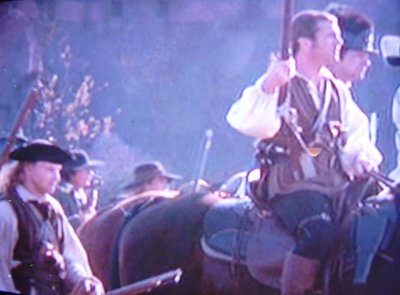
Filming, Keith and Mel Gibson
Keith Kankovsky, 1999 ©
|